
Mumbai doesn’t ease you in. It hits you — the noise, the smell, the sheer density of it — and then, almost immediately, it starts to make sense. There is a logic to the chaos, rhythms beneath the traffic, and once you find them, the city becomes one of the most energizing places on earth.
A weekend is not enough to get to know Mumbai. It is, however, enough to get a real feel for it — if you spend your time wisely. This guide covers two full days across the city’s most rewarding neighborhoods what to see, what to eat, how to get around, and why your choice of base matters more than most first-timers expect.
Hotel Metropole Inn sits in Andheri East — close to the airport, on the metro line, and better positioned for the actual city than the tourist-belt hotels in Colaba charge a premium to provide.
Day 1: South Mumbai — History, Architecture, and the Sea
South Mumbai is where the city’s story starts. Colonial-era architecture, a working waterfront, and a pace of life that still carries the weight of centuries make this the right place to begin.
Morning: Gateway of India and Colaba
The Gateway of India is the obvious starting point — and obvious for good reason. The 1924 basalt arch at the edge of the Arabian Sea in Colaba is genuinely impressive, and the early morning light on it is worth setting an alarm for. Built to mark the arrival of King George V and Queen Mary, it now stands as the city’s most enduring landmark, facing out toward the water as if waiting for something.
From here, you have a choice. If time allows, take the ferry to Elephanta Caves — a UNESCO World Heritage Site with rock-cut temples dedicated to Lord Shiva, about an hour each way across the water. If you’d rather stay on land, walk the Colaba Causeway instead: street vendors, antique dealers, seafood restaurants, and the steady hum of a market that has been trading for generations. Neither option disappoints.
Late Morning: Chhatrapati Shivaji Maharaj Terminus
A short auto-rickshaw or cab ride north takes you to CSMT — one of the most extraordinary buildings in India, and a UNESCO World Heritage Site. From the outside it looks like a Victorian Gothic cathedral; in practice it is Mumbai’s busiest railway station, processing hundreds of thousands of commuters daily.
The collision of Gothic Revival architecture with Indian decorative motifs — carved stone animals, peacocks, turrets that belong equally to both traditions — makes it unlike anything else in the subcontinent. You don’t need to go inside. Cross the street, stand on the pavement opposite, and look at it properly for five minutes. That alone justifies the detour.
Afternoon: Marine Drive and Chowpatty Beach
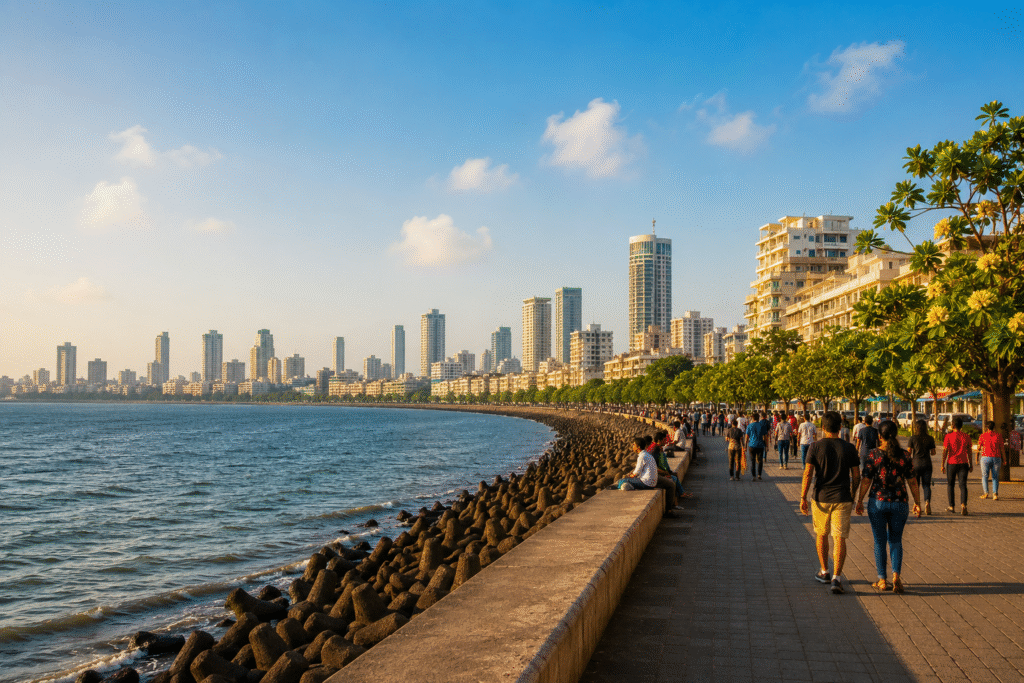
Marine Drive is a 3.6 km arc of promenade along the Arabian Sea. Locals call it the Queen’s Necklace — the curve of streetlights at night, seen from above, forms exactly that shape. In the afternoon it is quieter than you’d expect: a place to walk slowly, sit on the sea wall, and watch Mumbai exhale.
The promenade ends at Girgaon Chowpatty Beach, which is not a swimming beach but a social one — bhel puri stalls, families, vendors, and the general ease of a city that has found somewhere to be outside. This is the right place to eat bhel puri for the first time: puffed rice tossed with onions, tomatoes, tamarind chutney, and crunchy sev noodles. Tangy, light, and exactly right.
Evening: Bandra
End the day in Bandra — Mumbai’s most fashionable suburb, with the cafés, independent restaurants, and street art to prove it. The Bandstand Promenade as the sun drops into the sea is one of the city’s better quiet moments. After that, dinner on Hill Road or Waterfield Road offers everything from slow-roasted Goan fish curries to wood-fired pizzas to South Indian filter coffee at a pavement table.
Bandra sets the tone for what Mumbai’s more relaxed, residential life actually feels like — worth experiencing before the itinerary moves back to the tourist circuit.
Day 2: The Local City — Temples, Markets, and Street Food
Day 2 shifts away from landmarks and into the city’s working rhythms: a significant religious site, two of Mumbai’s most misunderstood neighbourhoods, and the street food that defines the place.
Morning: Siddhivinayak Temple
The Siddhivinayak Temple in Prabhadevi is dedicated to Lord Ganesha and is among the most visited places of worship in Maharashtra. Whether or not you are a devotee, the atmosphere here carries something genuinely affecting — the sound of devotional music, the smell of marigolds and incense, the mix of people who have travelled significant distances to be in this particular place. It is a good way to understand why Mumbai, for all its commerce and momentum, remains a deeply religious city.
Arrive before 9 AM on weekdays. The queue builds quickly, and patience thins in proportion.
Late Morning: Dharavi and Dhobi Ghat (Optional)
Two of the most photographed and least understood places in Mumbai. Both are worth considering if you want the city’s full picture rather than just its highlight reel.
Dharavi — often described reductively in international press — is in practice a densely functioning neighbourhood with a productive economy of cottage industries: leather goods, recycled materials, pottery, textiles. Several responsible operators run guided walks led by local residents and business owners. Done properly, it is not poverty tourism — it is a window into urban ingenuity at a scale that has no equivalent elsewhere.
Dhobi Ghat in Mahalaxmi is the world’s largest outdoor laundry — hundreds of washermen working in open-air stone wash pens, visible from the bridge above. It is one of those scenes that makes Mumbai feel unlike any other city, and the view from the bridge takes about ten minutes to absorb properly.
Afternoon: Linking Road and Juhu Beach
Linking Road in Andheri West is where Mumbai actually shops — clothing, shoes, accessories, and homeware at prices that reflect the local market rather than the tourist premium. The energy here is different from Colaba: faster, more transactional, and more honest.
A short drive west brings you to Juhu Beach, which exists primarily as a vehicle for street food and exists very well for it. The concentration of stalls along Juhu’s length is one of the most serious eating opportunities in the city.
The Juhu Street Food List
These are the dishes to find and eat in order:
- Vada Pav: A spiced potato fritter inside a soft pav roll, served with dry garlic chutney and fried green chilli. Mumbai’s most democratic food and its most addictive.
- Pav Bhaji: A thick vegetable curry — tomato, peas, capsicum, potato — mashed on a griddle with serious quantities of butter, served with pav rolls for scooping. Rich and filling in a way that justifies the walk afterward.
- Pani Puri: Hollow crispy spheres filled with spiced water, chickpeas, and potato. The vendor fills each one individually and hands it directly to you. Eat in one go. The spiced water is the measure of your spice tolerance.
- Sev Puri: A flat, crispy disc topped with potato, onion, multiple chutneys, and fine sev noodles. Sweet, sour, and spicy in the same bite.
- Cutting Chai: Strong, sweet, spiced tea served in half a glass — the ‘cutting’ refers to the portion. Drink it standing at the stall. This is how the city runs.
Evening: Andheri East — Dinner and Done
No need to travel back across the city on the second evening. The Andheri East area has a solid and varied spread of restaurants: Udupi vegetarian thalis, North Indian dhabas, biryani, and good South Indian filter coffee within a short auto-rickshaw ride from the hotel. After two full days, the absence of a commute at the end of the day is worth something.
Getting Around Mumbai: What First-Timers Should Know
- Metro: The cleanest, fastest option for cross-city travel
- Auto-rickshaws: Available throughout the suburbs including Andheri. Always insist on the meter. For distances under 5 km in the suburbs, autos often outpace cabs in heavy traffic.
- Ola / Uber: Reliable, metered, and the best option for longer distances to South Mumbai or late-night returns. Expect surge pricing during peak hours.
- Local Trains: The fastest way to cover long distances — but during rush hours (8–10 AM and 6–9 PM) the carriages are severely crowded. Travel off-peak if this is your first time on the system.
- Traffic timing: Mumbai traffic during peak hours can add 45 to 90 minutes to any journey. Sightseeing works best if you leave before 9 AM or after 11 AM, and aim to be back before 5 PM.
Why Andheri East is a Better Base Than You’ve Been Told
The conventional assumption is that first-time visitors to Mumbai need to stay in South Mumbai — near Colaba, or at a stretch, Bandra — to experience the city properly. The assumption is wrong.
Staying in Andheri East gives you several practical advantages that the tourist-zone hotels don’t advertise:
- 3.2 km from the international airport — early departures and late arrivals are genuinely manageable.
- Metro-connected — every part of the city is within 45 minutes without touching road traffic.
- Closer to the local, less-visited parts of the city — Juhu, Linking Road, Versova — where some of the best experiences in Mumbai actually happen.
- Hotel costs in Andheri East run significantly lower than equivalent hotels in Colaba or Bandra, which means more budget for the city itself.
Hotel Metropole Inn offers Classic and Premium rooms with free Wi-Fi, complimentary buffet breakfast, air conditioning, and 24-hour front desk support. Clean, comfortable, and sensibly priced — built around the needs of people who intend to spend their time in the city rather than their hotel.
Plan Your Mumbai Weekend
The best thing about Mumbai is that it gives back proportionally to the attention you bring to it. Take the itinerary above as a starting framework, deviate whenever something looks interesting, and use Andheri East as the practical base it is.
Book your stay: www.hotelmetropoleinn.com
Location: Andheri East, Mumbai — metro-connected, airport-close, city-ready